

Wisconsin Republicans Propose Fee for Foraging on State Lands
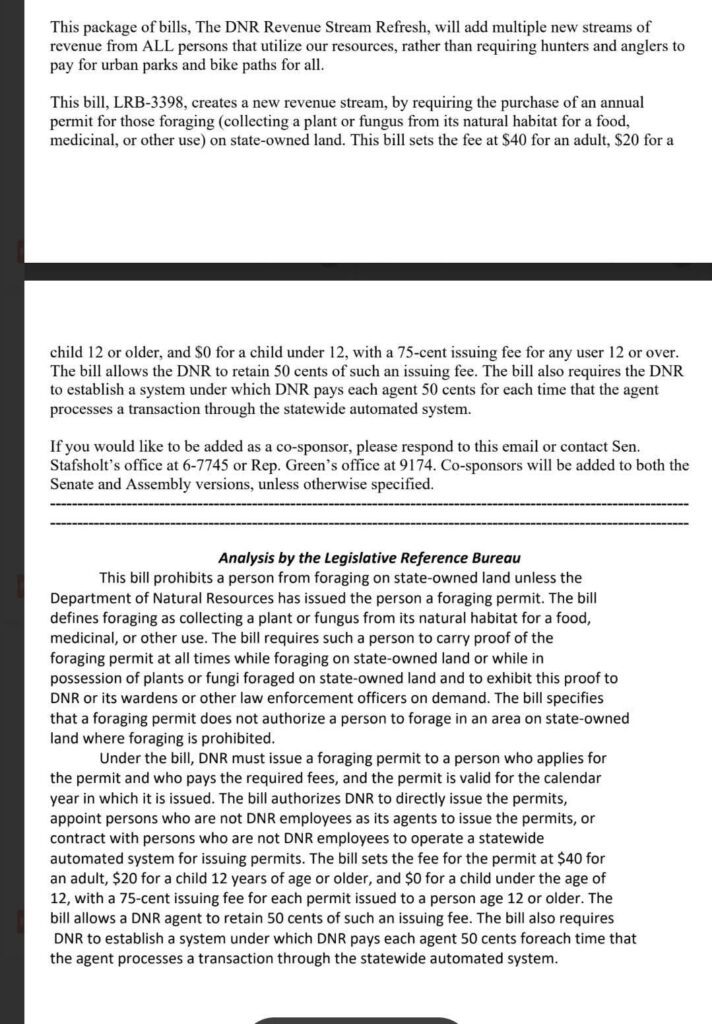
What the proposal would do The bill would create—for the first time in this context—a requirement that persons foraging (collecting a plant or fungus from its natural habitat for food, medicinal or other use) on state‐owned land pay an annual permit.
The excerpt you provided: $40 adult, $20 child age 12+, $0 for child under 12; + $0.75 issuing fee for those 12+; DNR may contract agents, etc.
Current law & background According to the DNR, foraging of edible fruits, nuts, mushrooms, asparagus etc for personal consumption on state parks, forests and natural areas is allowed without a permit. Wisconsin DNR+1
The proposed change therefore represents a new revenue stream from non-traditional users (not hunters/anglers) of state lands.
Rationale / motivations Proponents say this is part of a “DNR revenue stream refresh” to add “multiple new streams of revenue from ALL persons that utilize our resources, rather than requiring hunters and anglers to pay for urban parks and bike paths for all.” (Excerpt from the bill text below.)
The journalism article frames it as Republicans proposing new fees for activities like hiking, biking and foraging on public land. JSONline+1
Concerns / opposition Critics raise concerns about “taxing” outdoor recreation, increasing barriers for low-income users, undermining the principle of open access to public lands. (For example, the WisPolitics article frames it as “price hikes aimed at families who enjoy outdoor activities across our state.”) WisPolitics
Foraging communities may worry about whether smaller-scale users (berries, mushrooms) will feel disproportionately impacted or whether the permit will actually cover enforcement costs vs. deter casual foragers.
Implications for foragers, farms, land use If enacted, foragers will need to factor permitting cost into outings. Might discourage casual foraging.
Might push more foraging onto private lands or non‐state lands if permit cost is high.
Could raise questions about enforcement: how will DNR monitor foraging vs recreational walking? What counts as “foraging”?
For thought because I work in hemp, wild plants etc., the bill extends to “plant or fungus from its natural habitat for a food, medicinal, or other use.” So wild herbs, fungi, potentially medicinal mushrooms could be implicated.
What I will watch going forward
Check for the bill number, full text, committee hearings (who sponsors, timeline).
Look for amendments (fee amounts may change, exemptions may be added).
Look for stakeholder reaction: foraging associations, conservation groups, DNR.
Track how the permit would be structured: online system, issuing agents, penalties for non-permit possession.
Monitor budgets: will this actually raise significant revenue? Will it be applied equitably?
As an co-author of The Stoner’s Travel Guide to Wisconsin, this intersects with access to wild plants/fungi and forager culture covered in the book and I will be addressing the legislation via my social media networks.
📌 Next steps if you want to dig deeper
Seek the full bill text via the Wisconsin Legislative Reference Bureau or Wisconsin Legislature website; search for “LRB-3398” and/or keywords “foraging permit state owned land”. These LRB’s are hard to find on the website, so I have requested a copy of the legislation from my State Assembly Representative and State Senator and expressed my early concerns of what I am reading.
Monitor if any other news outlets have covered the bill beyond the Journal Sentinel (e.g., local TV, WPR, Examiner) for more context/quotes.
Reach out to DNR for comment on how current foraging permits and policies work and how they view the proposed change.
Engagement with: foragers, outdoor recreation advocates, DNR officials, or legislators sponsoring the bill.

Author: Jay Selthofner
Jay Selthofner is a business consultant, hemp farmer, political analyst, and cannabis activist in Wisconsin. He co-founded Northern Wisconsin NORML in 2010 and served as the chapter’s first Executive Director. He later served as the Treasurer until 2023. He also founded the Wisconsin Cannabis Activist Network (WISCAN) in 2010. Jay is an independent reporter of cannabis-related political news. His family owns Heritage Hemp Farm and the annual From the Land Folk Art Festival in Green Lake, Wisconsin. Jay is also a partner behind this website and The Stoner's Travel Guide series and co-author of the Wisconsin Edition.